
TL;DR
- Ahrefs studied 75,000 brands and found that branded web mentions correlate with visibility in Google's AI Overviews at 0.664, against 0.218 for backlinks. Ahrefs says plainly that this is correlation, not cause, and its sample was established domains. The link is still the only part of a placement Google documents as a ranking signal; the mention is what correlated with being named in AI Overviews. A PR plan has to produce both.
- Muck Rack's May 2026 study of more than 25 million links cited by ChatGPT, Claude and Gemini found that 84% were earned media. Journalism alone was 27% of those cited sources. Paid and advertorial content was 0.3%.
- In Google's own documentation the mechanism is the link. PageRank "continues to be part of our core ranking systems", and a crawlable editorial link is the one thing a placement hands over directly. A paid link that passes ranking credit is on the spam list.
- Nothing in this post guarantees a ranking or a citation. What it gives you is the mechanics, the four reasons coverage fails to show up in search, and an honest account of what Search Console can and cannot tell you afterward.
What is PR for SEO, and how is it different from traditional PR?
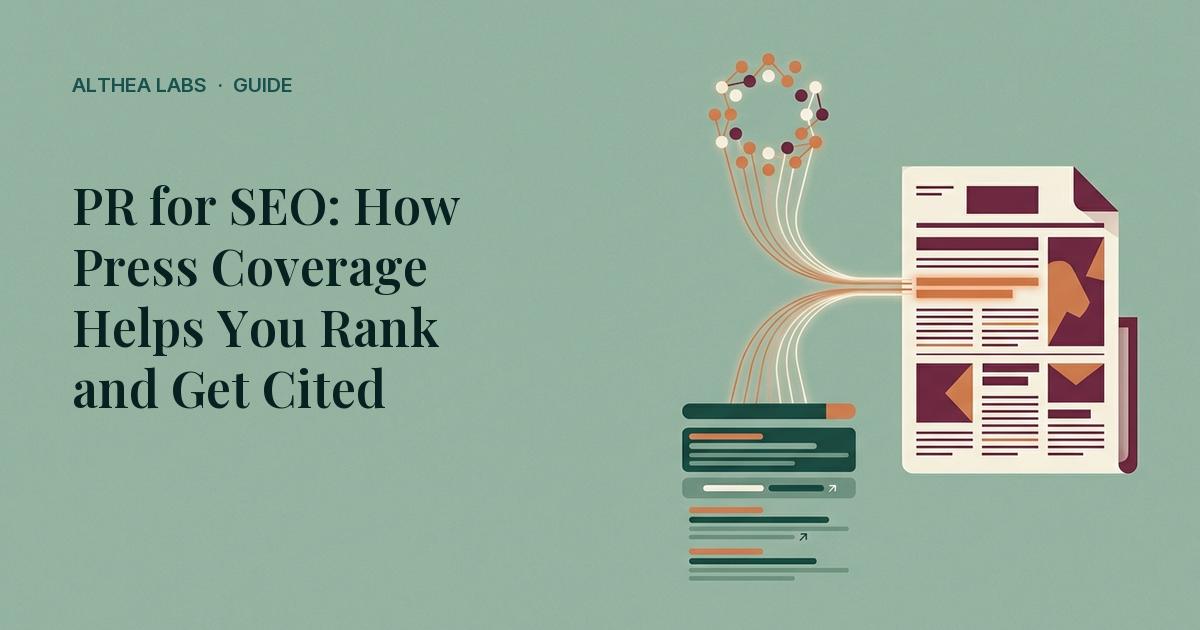
PR for SEO is press activity planned so the coverage does a second job after it is read: helping you rank in Google and get cited in AI answers. The placement carries a crawlable link to the page that answers the buyer's question, describes your company the same way your website does, and lands on an outlet that search engines and AI systems already draw on for your category. The story still has to be newsworthy.
Traditional PR measures the placement. It wants the logo, the reach and the reputation, and it treats the link as a courtesy. PR for SEO measures what the placement did afterward: whether Google found and credited the destination page, whether branded searches rose, whether an AI engine started citing the outlet when a buyer asked a question in your category. In our experience the second only works when the first is done well, because an engine cannot retrieve coverage that a journalist never chose to write.
You will also meet the term generative engine optimization, or GEO, which is the work of making a brand findable and citable by AI systems. Google's own view, in its guide to generative AI features, is that "optimizing for generative AI search is optimizing for the search experience, and thus still SEO." That is the position this post takes too: one set of mechanics, two places the results show up.
Does press coverage actually help you rank in Google?
Yes, but only one of the three routes Google documents is a ranking signal. Google does not describe press coverage as a ranking factor anywhere. It documents links, which feed ranking; promotion, which speeds discovery; and independent sources, which its quality raters are told to weigh but which Google does not describe as a ranking input. Coverage can supply all three.
The link is the part Google documents. Its link best practices say Google "uses links as a signal when determining the relevancy of pages and to find new pages to crawl." Its guide to ranking systems adds that PageRank, the system that reads how pages link to one another, "continues to be part of our core ranking systems." An editorial link from a relevant article is therefore one signal among many.
The link has to be a real one. Google says it generally crawls a link only if it is an HTML anchor element with an href attribute, and that "most links in other formats won't be parsed and extracted by Google's crawlers." For ordinary editorial links the publisher does not need to do anything special: Google's guidance on qualifying outbound links says that "for regular links that you expect Google to fetch and parse without any qualifications, you don't need to add a rel attribute."
Promotion speeds up discovery. Google's SEO Starter Guide says that "effectively promoting your new content will lead to faster discovery by those who are interested in the same subject, and also by search engines." A journalist's article puts your page in front of readers, crawlers and other writers who may reference it later. That is discovery rather than ranking, but a page nobody has found cannot rank at all.
Reputation is evidence Google's raters are told to look for. The Search Quality Rater Guidelines, in the edition dated September 11, 2025, tell raters to ask, "What do outside, independent sources say about them?" and add: "When there is disagreement between what the website or content creators say about themselves and what reputable independent sources say, trust the independent sources." The same guidelines say that "high quality news articles and informational articles may be good sources of reputation information."
Raters evaluate whether Google's systems are working; they do not rank pages. Google says so in its guidance on helpful content: "Search raters have no control over how pages rank. Rater data is not used directly in our ranking algorithms." So Google documents no reputation score for coverage to raise. What the guidelines do tell you is what Google considers good evidence: independent sources that describe your company accurately and agree with what your own site says. That is a standard you can write toward, not a signal you can buy.
Why isn't your press coverage showing up in Google?
When press coverage does not show up in Google, we check for four failures first: no crawlable link, a link to the wrong page, one wire release copied across many sites, or an article that describes your company differently from your own site. In each case the PR team measured the placement and never handed it to anyone who could make it count.
The link that isn't a link
A mention with no link, or a link built from a script event rather than an anchor element, gives Google nothing to crawl. Google does not document unlinked brand mentions as a ranking factor, so however warm the article is, the search system records the outlet's page and not yours. It may still send readers and still be retrieved by an AI engine, but it has passed no link signal.
The link that points at the wrong page
A story about your fraud-detection research links to your homepage. The homepage says nothing specific about fraud detection, so the link tells Google that your company exists and little about which of your pages answers that topic. Often the page that should have been the destination does not exist yet, because the SEO team heard about the story after it ran. We ask journalists for the specific page and leave the decision with them, and in our experience they usually agree when the page is genuinely the better destination for their readers.
The release that twenty sites ran
Twenty sites republish the same release with the same wording and the same link. That is one editorial decision repeated twenty times, not twenty independent sources, however the coverage report counts it. Google's spam policies name "links with optimized anchor text in articles, guest posts, or press releases distributed on other sites" as an example of link spam, while naming "wire service or press release service sites" as an example that is not inconsistent with its site reputation policy. Both are true at once: the wire is a legitimate distribution channel, and the links inside the copy are not an editorial endorsement of your page.
The company that describes itself three ways
An article uses last year's product category, a spokesperson title that changed in the spring and a founding date your own About page disagrees with. Each source is now describing a slightly different company. The rater guidelines quoted above send evaluators to independent sources and tell them to trust those sources over your site when the two disagree. Inconsistent facts turn your best coverage into a contradiction of your own website.
How does coverage get you cited by ChatGPT, Perplexity and Google's AI features?
The engines that search the web retrieve pages relevant to a question, then pick a few of them to cite. Coverage earns a citation when the article is accessible, answers the question being asked, and sits on a source the engine retrieves for that question. A prominent outlet can go uncited on a specific prompt if another page holds better evidence.
What the engines are reading
Muck Rack's May 2026 study analyzed more than 25 million links cited in ChatGPT, Claude and Gemini responses across 17 industries. Earned media, meaning coverage the brand neither wrote nor paid for, accounted for 84% of those links. Journalism alone made up 27% of the cited sources, and paid or advertorial content 0.3%. Two further findings matter for what you pitch. Industry trend questions drove journalism citations at more than double the rate of how-to questions. And press releases appeared almost exclusively in industry trend answers, at 3.5 times the rate they appeared in best-of queries. A release can be retrieved, then, but mostly when someone asks what is happening in a category rather than who to buy from.
Google says its AI Overviews and AI Mode are "rooted in our core Search ranking and quality systems," in the generative AI guide already quoted. The same page warns that "seeking inauthentic 'mentions' across the web isn't as helpful as it might seem." Genuine coverage supplies independent information those systems can retrieve; whether they retrieve it is the engine's decision, not yours.
The engines that cite live pages also have to be able to fetch them, and at OpenAI and Anthropic the crawler that does that is not the crawler that trains the model. OpenAI's publishers FAQ says that for content to appear in ChatGPT summaries and snippets you must not block OAI-SearchBot, while GPTBot governs training. Anthropic documents three crawlers: Claude-SearchBot for search indexing, Claude-User for pages fetched during a user's request, and ClaudeBot for training. It says disabling the first two "may reduce your site's visibility." A placement on a publisher that blocks those crawlers is one the engine cannot read or summarize; OpenAI says it may still show just the link and page title in its Atlas browser. You can check before you pitch: open the outlet's /robots.txt and look for OAI-SearchBot and Claude-SearchBot.
The correlation everyone quotes, and who it was measured on
Ahrefs studied 75,000 brands in May 2025 and measured Spearman correlations between search factors and how often a brand was mentioned in Google's AI Overviews. Branded web mentions scored 0.664, branded anchor text 0.527, branded search volume 0.392 and backlinks 0.218. Roughly 26% of the brands had no AI Overview mentions at all, and the analysis covers the remaining 74%. Ahrefs writes that "correlation ≠ causation" and describes every factor it studied as showing "moderate to very weak correlations."
Ahrefs filtered for domains with a Domain Rating (its own strength score) above 40, and took each domain's highest-volume keyword, which had to draw at least 800 searches a month. Those are established brands. A Series A company is on the other side of that filter, which means the numbers describe where you are trying to get to, not where you start.
The competition is not other press
Editorial coverage competes with community threads and reference pages for the same citation slots. A Semrush study of more than 150,000 citations found Reddit dominated as a leading source across the AI engines it studied. Foundation found Reddit accounted for about 21% of the top external citation domains across 50 B2B brands. Human voice wins. We treat community as a channel with its own calendar for exactly this reason, and Part 4 of the Althea Score explains how we read it. For the fuller account of how the engines choose, What is AI Visibility? is the place to start.
What can't PR do for SEO or AI visibility?
- It cannot guarantee a ranking or a citation. Google's advice on whether you need an SEO says "no one can guarantee a #1 ranking on Google," and its generative AI guide says "indexing and serving aren't guaranteed." ChatGPT, Perplexity and Google choose sources for each answer separately.
- It cannot raise your "domain authority." Domain authority is a third-party tool's metric. Google says that "no third-party tool has access to our internal ranking or AI systems," in the generative AI guide. Three of the 24 AI answers we sampled for this post said backlinks boost domain authority, and three more listed it as a metric to track, as if it were a Google signal. It is a vendor score.
- It cannot increase an E-E-A-T score. Google says that "E-E-A-T itself isn't a specific ranking factor," in its helpful content guidance. Experience, expertise, authoritativeness and trust are concepts its systems approximate with many signals, and of the four, Google says "trust is most important." There is no score for a placement to raise.
- Paid coverage cannot pass ranking credit. Google's spam policies list "advertorials or native advertising where payment is received for articles that include links that pass ranking credit" as link spam. Paid links are allowed only when the publisher qualifies them: Google prefers rel="sponsored" and still accepts rel="nofollow". A qualified link can still send readers, but it is not an editorial endorsement.
- Technical files cannot force AI visibility. Google says, in the same generative AI guide, that "structured data isn't required for generative AI search, and there's no special schema.org markup you need to add," and that Google Search ignores llms.txt files. A page has to be indexable and readable, which is the checklist in Part 2 of the Althea Score; no file on top of that compels an engine to cite it.
How should you plan PR so it actually helps search?
Plan PR so the page and the pitch answer the same buyer question: build the destination page before you pitch, keep your company facts identical everywhere, choose outlets by the questions AI answers already cite, and treat wire distribution as distribution rather than link building.
-
Build the destination page before you pitch. Write the page that answers the question behind the story, with the evidence that supports its claims, and ask the journalist to link to that page rather than the homepage. Leave the editorial decision with them.
-
Keep the company facts identical everywhere. One approved company description, one spokesperson title, one founding date, one product category, across the website, the press materials and every contributed comment. In PR Plus the messaging framework from the second step, ICP + Messaging, is where we settle that wording, which is why it comes before outreach rather than after. The cheapest reputation work you can do is to stop disagreeing with yourself.
-
Choose outlets by the questions you want to own. Before building the media list, run ten to fifteen of your category's buyer questions through ChatGPT, Perplexity and Google's AI features, three times each, and record which publications, trade sites and communities the answers cite. Pitch the sources that already appear. We run that measurement as PR Plus's third step, Visibility Tracking, with Gauge, the AI visibility measurement platform we use with clients: a baseline of 300 to 500 prompts pulled from real conversations, then a tracked set re-run every month. The media list that comes out of it is part of the fourth step, Strategy. When we ran the six prompts this post is written for, the answers cited newswire vendors and agency blogs far more often than Google's own documentation, which is one reason this post quotes Google directly.
-
Treat wire distribution as distribution. A release on a wire creates a public record, gives journalists source material and reaches the trend-question answers Muck Rack found it in. It is not a link-building plan. We wrote how to write a press release for AI discovery and trust because the release still matters as a source document; it just does not substitute for a journalist deciding to cover you.
How do you measure whether PR is moving search and AI metrics?
Keep the four records from our buyer's guide to choosing a PR and SEO agency: the placement, the citation, the visit and the outcome. Label every conclusion Observed, Associated, Attributed or Causal, and do not let a report blend them. The framework is written out in full there; this section covers only what PR adds.
Two things Search Console will show you
Branded demand is the search metric to watch first. In the Search Console Performance report, filter queries to those containing your brand name, compare impressions and clicks for the four weeks before and after the story, and file the result with the placement, dated. Log a change as Associated: the records show branded demand moved after the story, not why.
Google's AI features are the blind spot. Clicks from AI Overviews and AI Mode are folded into that same Web search traffic, and the separate Generative AI performance report every property has had since August 31, 2026 counts impressions and no clicks.
The question your signup form should ask
Configure the actions that matter as GA4 key events and pass leads into the CRM, then add one field to the signup or sales form: "How did you hear about us?" Click-based attribution can badly undercount discovery through coverage and AI answers, because the reader who saw your name in an article and later typed your URL arrives as direct traffic. Graphite's n8n example shows the size of the gap for one company: GA4 last-touch credited AI with 0.9% of conversions, while the post-signup question credited it with 9%. That is one company's self-reported data, not a benchmark, and it is the reason we read referral data and customer-reported discovery side by side rather than picking one.
Do you need a PR agency, an SEO agency, or both?
You need both functions. Whether you need two vendors depends on who owns five jobs: the audit, the messaging, the tracking, the strategy and the execution. We put the scoring card we use for that decision in our buyer's guide, including what to ask and what disqualifies an agency.
FAQs
Which page should the coverage link to? The page that answers the question behind the story, not the homepage. If that page does not exist yet, write it before you pitch, then ask for it by name and leave the decision with the journalist.
Do unlinked brand mentions help SEO? Google does not document unlinked mentions as a ranking factor, or confirm that they improve entity recognition. It does say its generative AI features can show "what's being said about products and services across the web," so an unlinked mention can still turn up in what an engine retrieves for an answer. Anything stronger than that is speculation.
Does a press release on a wire service help rankings? Not directly. It spreads the news, creates a public record and, in Muck Rack's data, gets retrieved mostly for industry-trend questions. Syndicated copies are not separate editorial endorsements. Use the wire to distribute, not to build links.
Does nofollow coverage still count for anything? Yes, for readers, referrals and presence in an independent source an AI engine may retrieve. It does not count as a regular editorial link, and you should not log it as one in the placement record.
How long before coverage shows up in AI answers? There is no fixed timetable. An engine has to retrieve the page, judge it relevant to the prompt and select it, and some coverage never appears. Track a fixed prompt set on a schedule, three to five runs per check, instead of expecting a citation the week the story runs.
Can one big placement move rankings? Not on its own. One placement can produce a useful link, referral visits and follow-on coverage from writers who pick up the story, but its link is one signal among the many Google uses, so treat any promised ranking change as a claim to check against your own baseline.
Get an audit before you spend on PR
Presence beats fame. Coverage creates search and AI value when it lands on a page an engine can read, describes a company that agrees with itself, and reaches the outlets the engines already draw on. Placement volume cannot compensate for a site that gives search engines and AI systems little usable information.
Althea Labs is a brand presence and AI visibility agency that builds targeted visibility systems for B2B startups through integrated PR, SEO, and content programs. We call the method PR Plus. It has four components, Authority (traditional PR), Infrastructure (SEO and schema), Human Proof (community) and The Bridge (content), and it runs in five steps: Audit, ICP + Messaging, Visibility Tracking, Strategy and Execution.
Every engagement we run starts with the Audit, because these four failures only show themselves when the placement log, the pages it points to, the wire pickups and the company facts sit side by side, and in most companies no one person owns all four. The Brand Intelligence Audit is also sold on its own: five days, delivered as a deck and a one-hour session. If you want to know whether your current PR plan is doing the second job this post describes, start with an audit.
CONTINUE READING