

In Q4 2025, our client Major League Hacking (MLH) published two partnership announcements seven weeks apart, and we treated the pair as an experiment in writing press releases for an AEO world (answer engine optimization: writing so that AI answers can find and cite you). The first, on 22 October, announced a three-year partnership with Google Cloud to integrate Gemini models across MLH’s global network. The second, on 9 December, announced a collaboration with Solana to expand access to blockchain education. By the time the second went out, we had started tracking the first in Gauge, the AI visibility measurement platform we use with clients. Here is what we did differently on the second.
MLH’s announcements were well timed. Both announcements were:
- Legitimate partnerships
- Distributed through similar channels
- Mission driven
Answering the Question: How Must Press Release Strategy & Creation Change to Reach Search & AI Needs?
The problem: AI systems and automated summaries handle written announcements differently. It wasn't about which partner was bigger or which news was more important. Althea Labs discovered that what worked best was clarity. And we set out to answer the basic "who, what, why" questions in a format that worked for both.
To see whether the second approach made a difference, we used Gauge to track how often AI answers cited each press release, one of the main measures of AI visibility.
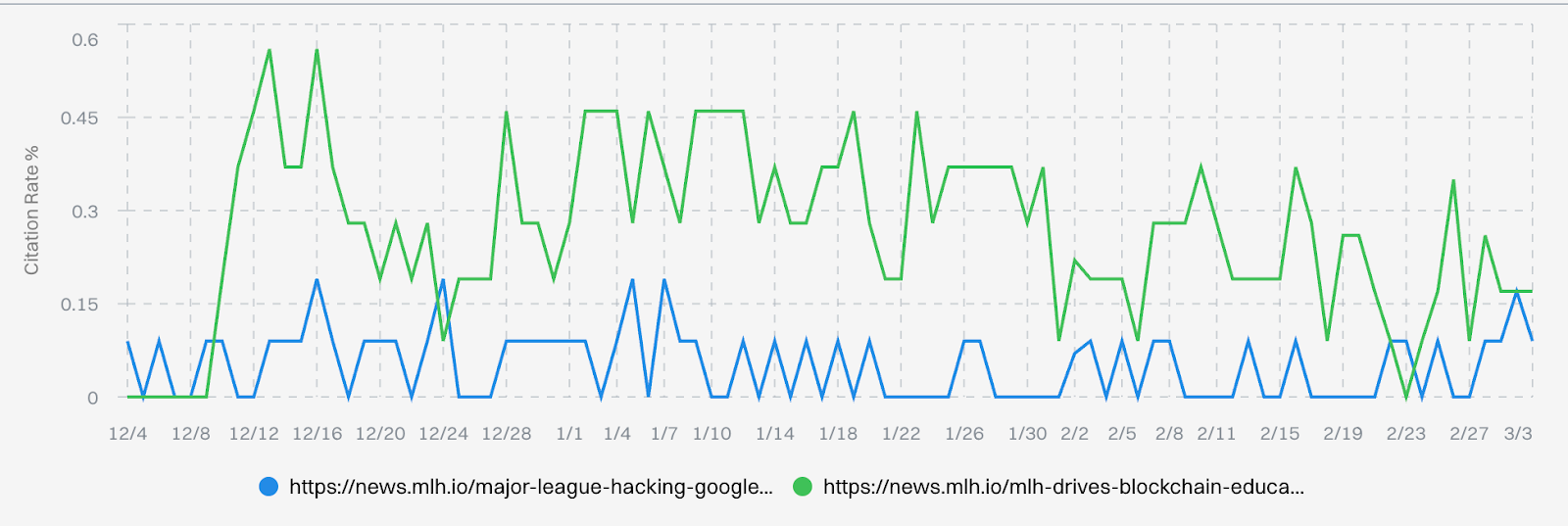
The chart tracks daily AI citation rate in Gauge from 4 December 2025 to 3 March 2026. For most of that window, the Solana release, which we approached with AI visibility in mind, had the higher daily citation rate. One caveat before the lessons: the two releases had different partners and different news, and the Google Cloud release was already six weeks old when tracking began, so this is an observation, not a controlled test.
As AI increasingly dictates how our news gets summarized and recycled, we’ve learned that the structure, clarity, and language you use are everything, and we will continue to refine our approach with this in mind.
Writing Press Releases for Machines & Humans
Publicists have long practiced a structured approach to releases that highlights factual details, contextualizes announcements for culture, and puts company spokespeople on center stage to tell the story in their own words. Our approach let us continue this tradition while tweaking specifics to better appeal to LLMs and search engines. The full checklist is in our guide to how to write a press release in 2026; the lessons below are where it came from.
Factual Headlines Answer Search Questions
From an AEO perspective, the Solana headline is a quick, easy-to-digest fact while the Google headline is more of a mission statement. For machines, facts will always win out over jargon.
The Solana announcement hit the sweet spot right away. The headline, "Major League Hacking (MLH) to Accelerate Blockchain Education for Student Developers, Focused on Solana," reads as a direct response to a search question like “What is MLH doing with Solana?” It clearly answers who is involved, what is happening, who it’s for, without needing interpretation. Plus, the subhead on the wire-service version reinforces the message by saying they're bringing Solana to hackathons, fellowships, and micro-grants.
The Google Cloud headline, as the wire-service version ran it, "Major League Hacking (MLH) Partners with Google Cloud to Build Pipeline of AI-Native Engineers," is more abstract, with jargony words like "pipeline" and "AI-native." It sounds ambitious, but it doesn't immediately tell you what students will actually do.
Leading the Reader with a Strong Introduction
Machines (and people) appreciate clarity. This is the power of a strong lead.
The first paragraph of the Solana press release acted as a structured fact block. The information was told right away.
- Who: MLH, with Solana
- What: A blockchain education initiative
- For Whom: Student and next-gen developers
- Where: MLH hackathons, building on Solana
- Why It Mattered: Hands-on practice & a way into an active developer community
The Google Cloud intro led with heavy information: a three-year, multimillion-dollar collaboration, Gemini models, and 4,000-plus community chapters, without immediately explaining what developers would actually do with any of them.
The Solana intro defined the actual program, while the Google intro announced a relationship.
Structured Storytelling
One of the strongest advantages of the Solana release was its structure. Search engines and LLMs seek direct answers to questions like "How can I, a developer, get involved?" or "What specific programs can I use to build with Solana through MLH?"
We broke the Solana partnership into segments rather than telling a drawn out story. Hackathons, workshops, fellowships, micro-grants, and initiatives like “100 Days of Solana” were presented as separate elements. The Google Cloud release followed a Phase 1, Phase 2, Phase 3 narrative explaining how Gemini would gradually show up in hackathons, conferences, and student chapters.
While a linear story is more aesthetically pleasing to human readers, search engines don't appreciate aesthetics (yet, at least). Machines prefer simple lists of features or activities they can pull out and summarize individually. Distinct, modular lists worked much better for getting noticed and reused online than the gradual "rollout" story.
Quotations Must Do More Than Tell A Story
The quotations in the Solana announcement told readers exactly what they'd be building, how they'd learn, and why getting into the Solana world was a big deal. On the other hand, the Google Cloud quotes were more about the big picture, about strategy, getting industry approval, and the long-term plan. While they definitely boost credibility and tell a good brand story, they didn't really give us much new information. What we learned from looking at both is that AI systems are way more likely to reuse quotes that simply explain how a program works than quotes that just argue for or give context to a strategy.
Simple Facts Perform Better Than Big Ideas
The Solana launch was easy for people to grasp because it all revolved around one main thing. It was centered on a single dominant ecosystem, with everything connecting back to Solana as the platform and MLH as the facilitator.
The Google Cloud release introduced multiple overlapping entities: MLH, Google Cloud, Gemini models, and the whole AI world, which diffused the narrative. If the story is clearly anchored to one platform, search engines can more easily connect the dots to what people are asking about.
Learning in Public While the Playbook Is Still Being Written
The world of media is changing fast, and with AI stepping in more often, we're making a conscious effort to slow down. We're learning to slow down and be more deliberate, to choose words that explain rather than impress, and to design a structure that supports understanding rather than just announcement. For us at Althea Labs, real growth isn't about getting everything perfect right away. It's about really observing, asking smart questions, and then always applying those lessons to make the next project even better. This thoughtful approach guides how we think, write, work together, and respect the stories our partners trust us with. It is also why a release is one input to a larger system in PR Plus rather than the end goal. Part 3 of the Althea Score covers what AI engines cite and how much of it is earned coverage like this.
Ready to See Where You Stand?
Every Althea Labs engagement starts with an audit. We show you exactly where your brand stands in search, in AI, and in the communities where your buyers actually are, then show you what it would take to build from there.
CONTINUE READING